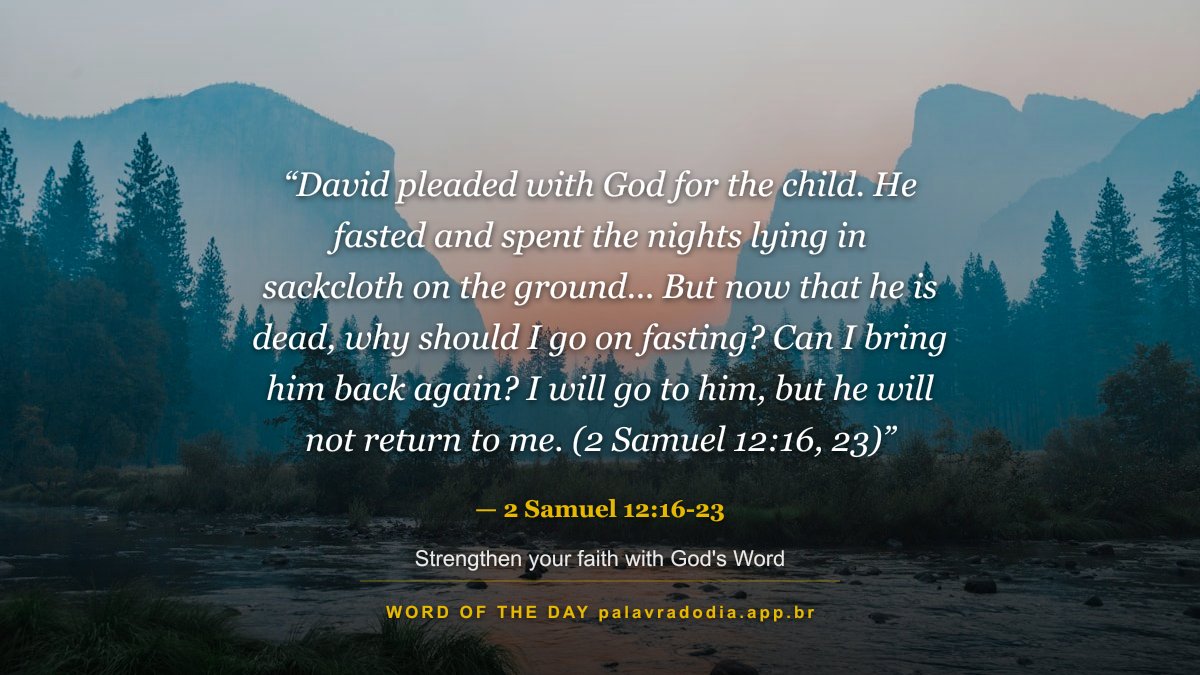
Bible Scripture of the Day: Navigating Loss and Grace in 2 Samuel 12 — 2 Samuel 12:16-23
Reflexão e Oração de Hoje
Por Word of the Day Ministry • April 23, 2021
Historical Context and the Weight of Royal Guilt in 2 Samuel 12
The narrative of 2 Samuel 12 emerges from one of the darkest chapters in the life of King David. Having fallen into the grave sins of adultery with Bathsheba and the calculated murder of her husband Uriah, David stands exposed before the piercing gaze of the prophet Nathan. The consequences of human transgression are profound, cascading into the illness of the child born from this union. In Hebrew culture, kingship was deeply intertwined with divine favor, and public or private catastrophes carried heavy theological implications regarding covenantal obedience. Yet, this text refuses to flatten David into a mere villain or a stoic untouched by tragedy.
When the child falls gravely ill, David responds with profound humility and agonizing intercession. The text employs visceral Hebrew imagery: David fasts, goes into seclusion, and lies prostrate upon the earth all night. This was not a mechanical ritual to manipulate the Almighty, but an outpouring of raw, broken grief from a contrite heart. He understood the holiness of God and the gravity of his own failings, casting himself entirely upon the mercy of the Creator. The original audience of this text would have recognized the posture of true repentance—a total abandonment of self-reliance in the presence of divine justice.
However, the divine verdict is rendered, and the child passes away. In ancient courts, servants feared how a volatile king would receive such devastating news, anticipating rage or despair that could threaten the stability of the kingdom. Yet David's reaction defies every cultural expectation. He rises from the floor, washes, anoints himself, changes his clothes, and goes to the house of the worship the Lord. This sudden shift from relentless mourning to resolute acceptance startles those around him, prompting a theological declaration that bridges human sorrow with eternal perspective.
The Theology of Surrender: Understanding the Divine Will
David's famous declaration—'I will go to him, but he will not return to me'—encapsulates a mature theological understanding of human finitude and divine sovereignty. In moments of profound loss, whether through the finality of death or the shattering of deeply invested human relationships, the human heart naturally rebels against closure. We bargain, we plead, and we exhaust our emotional reserves trying to reverse the irreversible. David exhaustively petitioned God while the situation remained within the realm of petition. But once the boundary of God's sovereign decree was crossed, he ceased his fasting. He recognized that grief, though entirely legitimate and necessary to process, must not be allowed to become an idol or a prison.
This dynamic touches upon the core of how we process brokenness in a fallen world. When earthly ties dissolve, whether by tragedy or human choice, we often struggle to release what was never ultimately ours to possess. True spiritual maturity involves resting in
the divine wisdom that governs our limitations, accepting that we cannot manipulate reality to fit our desires. God's grace does not exempt us from the pain of separation, but it fortifies the soul to endure the silence that follows an earth-shattering loss.
Furthermore, the text challenges our tendency to confuse love with possession. As the Apostle Paul later articulates, love does not insist on its own way. When we have poured our time, affection, and prayers into a person, a ministry, or a dream that ultimately reaches its end, grace empowers us to let go. Clinging desperately to a ghost of the past paralyzes our spiritual vitality. David grieved deeply, but he refused to let his sorrow eclipse his ongoing relationship with the living God. His ability to rise, worship, and continue his journey demonstrates that God's mercies are new every morning, even when yesterday ended in sorrow.
Walking Through Grief Into New Beginnings With God
Applying this narrative to our contemporary lives requires brutal honesty paired with tender divine comfort. Modern culture often encourages either a toxic positivity that suppresses grief or an endless rumination that glorifies victimhood and paralyzes progress. The biblical pattern offers a superior, healing path: we are permitted—indeed, commanded—to weep, to pour out our anguish before God with unfiltered authenticity. Yet, like David, we must recognize the boundary where mourning transitions into stagnation. When relationships fracture or cherished dreams expire, we must make the deliberate choice to rise, dust off the ashes of regret, and re-engage with the present.
In our professional callings, familial responsibilities, and spiritual walk, unresolved bitterness over past losses acts as a heavy anchor, dragging down our capacity to receive
the restorative peace provided by our ultimate Shepherd. To move forward requires the difficult labor of forgiveness—not only forgiving those who may have caused the rupture, but forgiving ourselves for our limitations. We must release the illusion of control. When we stop trying to force dead situations back to life through sheer human willpower, we open our hands to receive what the Lord is currently cultivating in our lives.
This transition is rarely instantaneous. It involves moments of quiet reflection, tears shed in secret, and the gradual rebuilding of daily routines. Yet, because God is the author of redemption, every genuine ending in the believer's life carries the seed of a new beginning. We do not walk into tomorrow alone or empty-handed; we carry the lessons of grace, the refinement born of suffering, and the unshakeable assurance that our true home and ultimate satisfaction are securely anchored in eternity.
The Unfailing Anchor of Divine Hope Amidst Life's Ruins
The overarching testimony of Scripture is that God specializes in bringing resurrection life out of places of absolute finality. When David walked away from the child's room and entered the house of the Lord to worship, he was acknowledging that God remains worthy of praise even when His answers take the form of a closed door. This is the hallmark of resilient faith: it does not demand that God explain His sovereign choices, but rests entirely in the unchanging goodness of His character. Spiritual disciplines such as prayer, fasting, and corporate worship are designed precisely for these valley experiences, lifting our gaze from earthly rubble to heavenly reality.
As we process our own griefs and relational fractures, we are invited to view them through the lens of ultimate redemption. The losses we suffer in this temporal realm are real and heavy, but they do not have the final word. In Christ, every tear is collected, every broken piece is accounted for, and every apparent dead end is transformed by the Master Weaver into a pathway of deeper communion with Himself. Let us therefore process our sorrows with honesty, release our grip on the uncontrollable, and step forward with confidence into the vast, grace-bathed horizon of God's tomorrow.
Verses for Reflection and Strength
Ecclesiastes 3:1, 4
“There is a time for everything, and a season for every activity under the heavens... a time to weep and a time to laugh, a time to mourn and a time to dance.”
Psalm 34:18
“The Lord is close to the brokenhearted and saves those who are crushed in spirit.”
Revelation 21:4
“He will wipe every tear from their eyes. There will be no more death or mourning or crying or pain, for the old order of things has passed away.”
Receive God's Word Daily on Your Phone
Install our free app to receive daily morning prayer notifications and inspirational devotionals.
Today's Prayer
Heavenly Father, Almighty and Merciful God, we come before You with quieted hearts and spirits laid bare. You alone understand the deep sorrows we carry, the griefs of unfulfilled prayers, the pain of broken relationships, and the heavy reality of loss that touches every human life. Grant us the grace to mourn honestly without yielding to despair. Help us to release into Your sovereign hands the people, dreams, and circumstances that we can no longer hold. When we face the finality of earthly doors closing, lift our eyes beyond the rubble of the past. Heal our lingering bitterness, wash away our regrets, and renew our strength for the journey ahead. Teach us the profound art of surrender, knowing that You are a God of new beginnings and resurrection power. Fill our empty spaces with Your presence and anchor our hope firmly in Your unfailing love. In the precious and name of Jesus Christ, we pray. Amen.