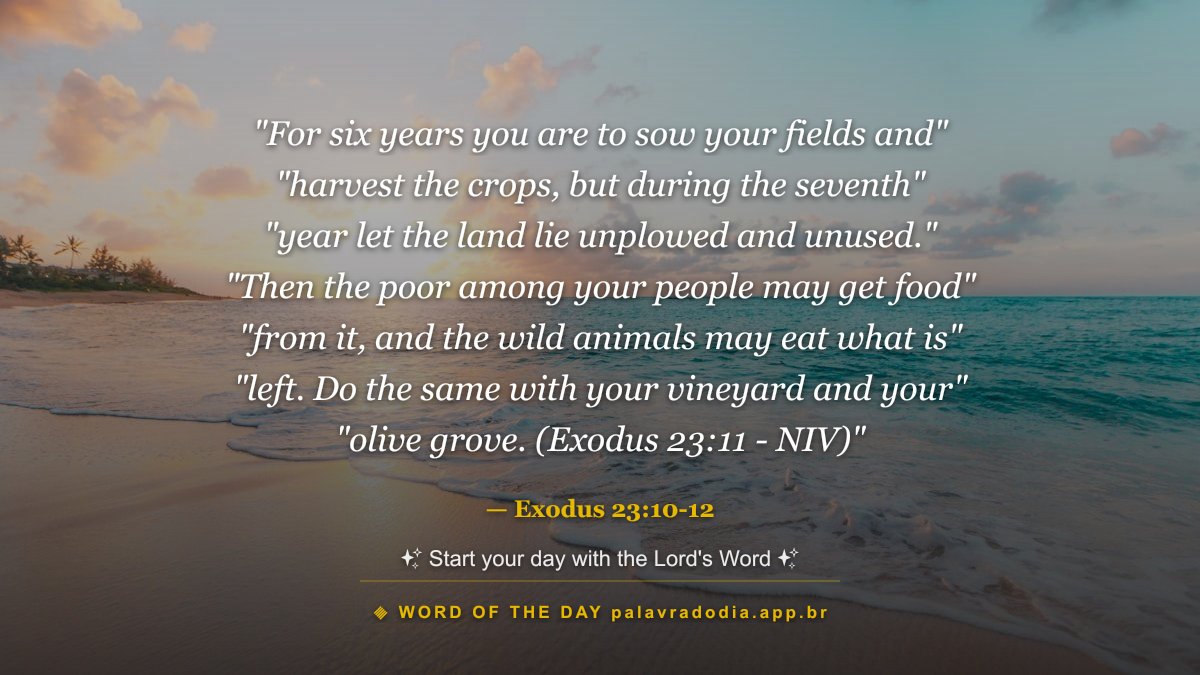
Verse of the Day: God's Heart for the Poor and Creation in Exodus 23 — Exodus 23:10-12
Reflexão e Oração de Hoje
Por Word of the Day Ministry • September 16, 2026
The Historical and Cultural Context of Exodus 23
As we examine our designated verse of the day from Exodus 23:10-12, we step into the foundational socioeconomic framework that God established for ancient Israel. In the agrarian culture of the Old Testament, the land was not merely a commodity for endless wealth accumulation; it was a sacred trust given by Yahweh. The instruction to leave the land fallow every seventh year—known as the Sabbath year—carried profound theological and practical implications. It was a radical test of faith for landowners, demanding that they trust in divine provision rather than human hoarding.
In the original Hebrew text, the provisions for the Sabbath year intersect deeply with the Hebrew concepts of justice ('mishpat') and righteousness ('tsedaqah'). God commanded that the spontaneous harvest of the fallow fields should be left accessible. Why? So that 'the poor among your people may get food from it, and the wild animals may eat what is left.' This legislation dismantled the merciless cycles of human greed, ensuring that the most vulnerable margins of society—and even creation itself—were enveloped in God's tender care.
The Theological Reflection: Grace Against Human Selfishness
When Jesus later uttered the poignant truth, 'The poor you will always have with you' (Matthew 26:11), He was not excusing indifference; He was acknowledging the ongoing reality of a fallen world. Ever since humanity's tragic rebellion in Eden, systemic inequality, poverty, and suffering have fractured the human community. Human selfishness naturally gravitates toward hoarding resources, building bigger barns, and closing our hearts to the cries of the destitute. Yet, the heart of God beats with relentless compassion for the marginalized.
This divine mandate in Exodus reveals that God's grace is never passive or merely abstract; it is deeply structural and communal. The Creator cares for the destitute, the stranger, the orphan, and the widow because they bear His image. Furthermore, extending this provision to wild animals demonstrates an expansive, cosmic stewardship. God’s compassion covers the entire ecosystem. When we meditate on a day by day bible verse like this, we are reminded that true worship cannot be divorced from active love and justice toward the vulnerable around us.
Practical Application for Daily Life, Work, and Anxiety
How do these ancient agrarian laws translate into our modern, fast-paced lives of corporate anxiety, family responsibilities, and digital pressures? First, the Sabbath year principle challenges our deep-seated anxiety regarding scarcity. Many of us struggle with overwork and burnout because we operate under the illusion that our security depends solely on our relentless hustle. Trusting God with our 'seventh year' means learning to rest, setting boundaries, and recognizing that our worth is not measured by our productivity.
Second, this passage redefines how we approach our finances, careers, and family life. Are we willing to share the surplus of our time, talents, and resources with those in genuine need? In our workplaces and neighborhoods, we are called to be agents of divine generosity. Whether it is supporting local community initiatives, advocating for the oppressed, or simply noticing the overlooked individuals in our daily routines, living out a bible passage of the day requires intentional, hands-on compassion that disrupts our comfortable routines.
Perseverance, Hope, and the Eternal Promise
Walking in step with God's commands often requires enduring faith, especially when cultural pressures encourage individualism and materialism. Yet, the biblical quote for today serves as an anchor for our souls, assuring us that God honors those who reflect His generous character. When we choose generosity over greed and trust over anxiety, we participate in the unfolding kingdom of God right where we are.
Let us take heart, knowing that our acts of kindness, hospitality, and mercy are seen by our Heavenly Father. He who feeds the wild animals of the field and provides for the poor will certainly sustain us as we walk faithfully in His calling, looking forward to the ultimate restoration of all things in Christ.
Related Verses for Meditation
Deuteronomy 15:11
“There will always be poor people in the land. Therefore I command you to be openhanded toward your fellow Israelites who are poor and needy in your land.”
Proverbs 19:17
“Whoever is kind to the poor lends to the Lord, and he will reward them for what they have done.”
James 1:27
“Religion that God our Father accepts as pure and faultless is this: to look after orphans and widows in their distress and to keep oneself from being polluted by the world.”
Receive God's Word Daily on Your Phone
Install our free app to receive daily morning prayer notifications and inspirational devotionals.
Today's Prayer
Heavenly Father, we come before You with grateful hearts, acknowledging Your boundless provision and unfailing love. Forgive us, Lord, for the times our hearts have grown cold, selfish, or anxious about our own security, causing us to overlook the poor and vulnerable around us. Grant us the grace to live out the deep truths found in Your Word today. Help us to trust You with our resources, our time, and our future. Cultivate within us a spirit of radical generosity, compassion, and stewardship that mirrors the heart of Jesus. May our hands be open to help those in need and our lives be a living testimony of Your redeeming grace. In Jesus' mighty name, we pray. Amen.